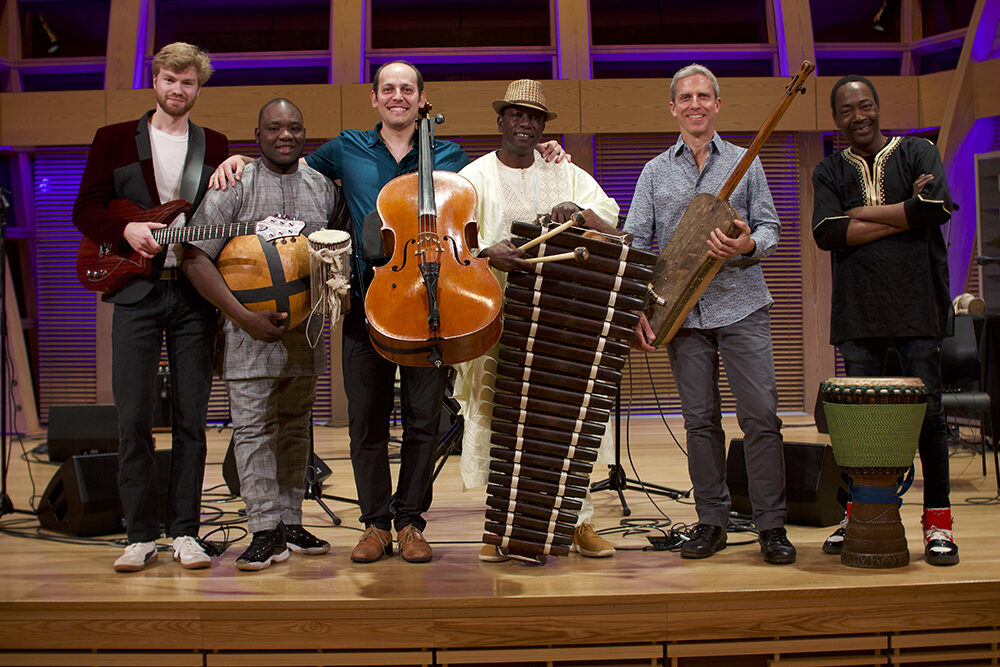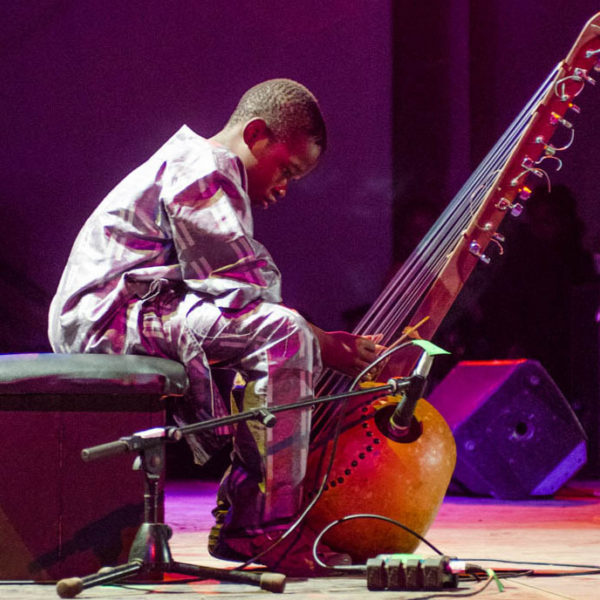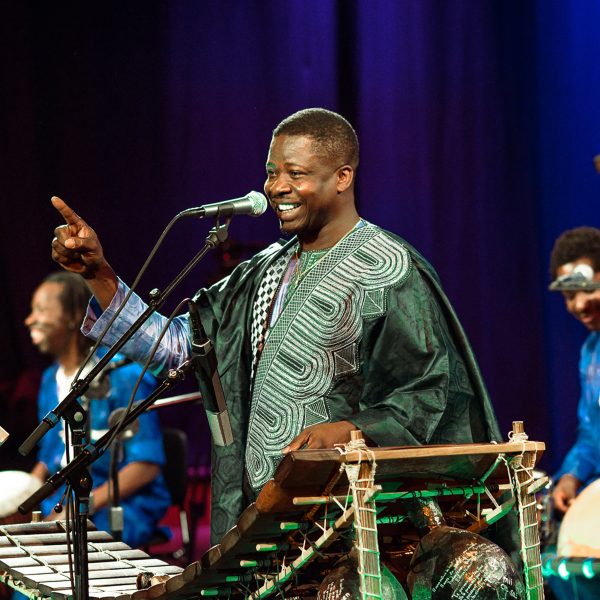






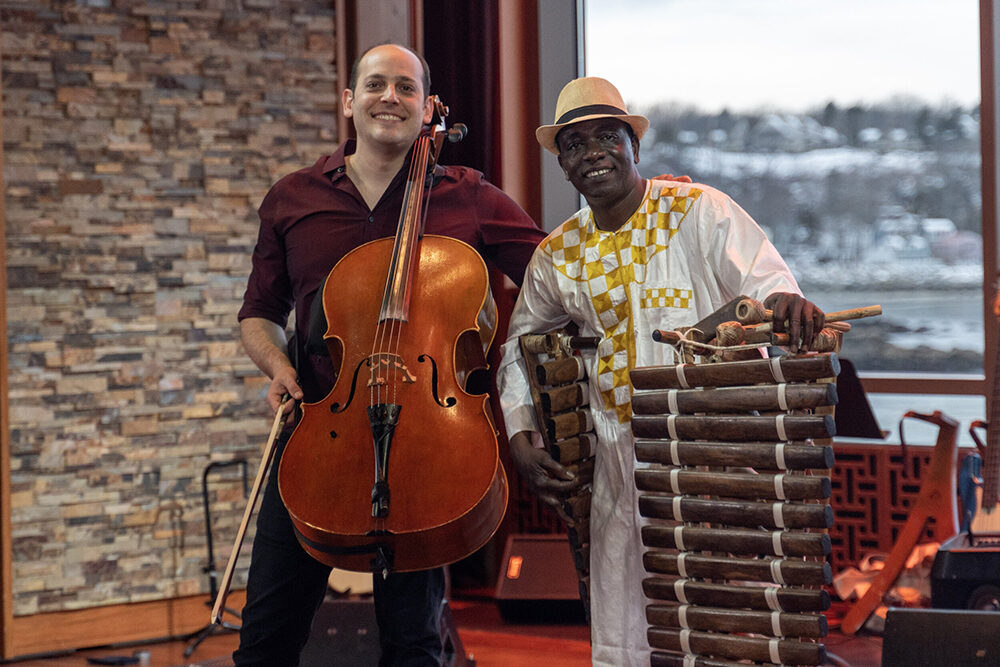
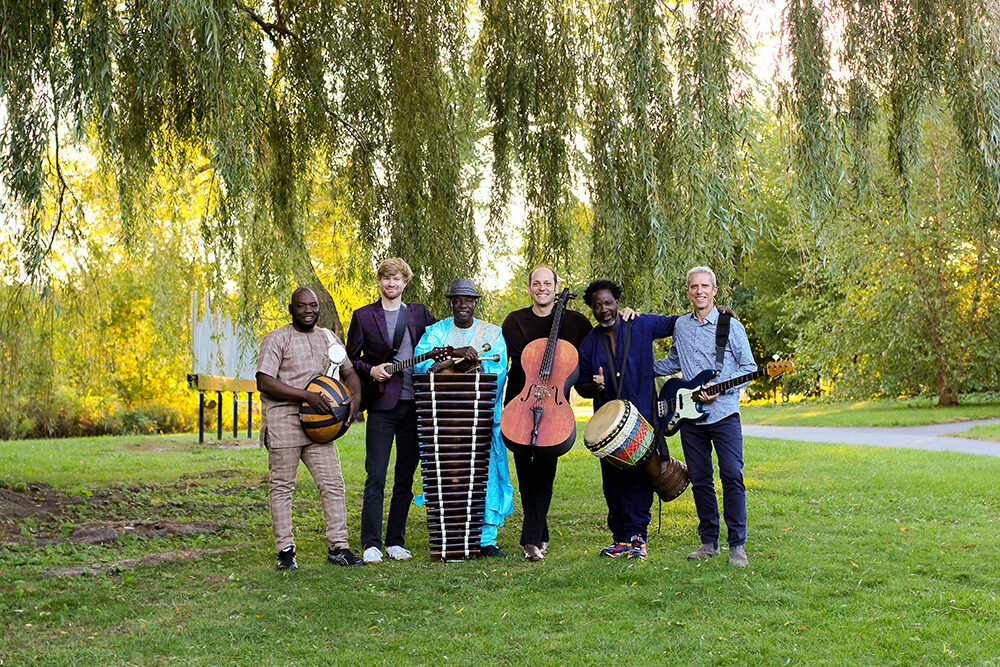
Cello maestro Mike Block is shaking up Boston’s music scene these days. Leading at least three ensembles, all very different, Blocks is taking what he calls “the greatest of all musical instruments” to places it has never been before. Of special interest to Afropop is Block’s new, six-piece band Djékady, co-led by Guinean balafon virtuoso Balla Kouyaté. The group also features Idrissa Kone (percussion), Sekou Dembele (djembe), Luke Okerlund (electric guitar), and Mike Rivard (electric bass/sintir). Their debut album Benkan, meaning “agreement” is just out and it’s a fascinating mix of original compositions, Mande traditional songs and Americana. Djékady means “It’s good to come together,” and these six certainly prove that point. On its face, this may look like a multi-cultural ensemble, and on one level, it is. But for Block, this is a quintessentially American band, as Afropop’s Banning Eyre found out in a recent Zoom interview with the cellist. Here’s their conversation.
Banning Eyre: Mike, it’s great to connect. Let’s start with your background. Give me your thumbnail bio, how you came to use this this ostensibly classical instrument in all these non-classical ways?
Mike Block: Sure. Well first, I play the greatest of all musical instruments, the cello, obviously.
I get that.
Growing up, my whole family was full of classical musicians. My dad is an orchestra conductor. My mom used to play French horn, and my siblings are string players. And so, for me, that was just the path of normalcy that I was on. I was getting support and lessons and ended up going to college to study classical cello. It was during college that I basically confronted my own unhappiness and realized I wasn't feeling the things in music that I wanted to be feeling. That's what kind of spurred me on. Basically, my choice was either, maybe I'll quit music, or I'll try all this other stuff that is actually in the back of my mind, and what I think I wanted to do this whole time.
Was this happening in Boston?
No. I went to college at the Cleveland Institute of Music and then did graduate school at the Julliard School of Music in New York. I do live in Boston now, but I grew up in Kansas City. So I've moved around, but for me the path to fulfillment with music was through improvisation and composition and just the freedom to be more exploratory. This was a feeling that I was finding outside of classical music. My path really started to diverge from what everybody else around me in school and in my family were all aiming for. Honestly, I was struggling. Maybe I'm playing the wrong instrument; maybe I'm in the wrong music community.
Somehow I never did give up the cello, and I started to get some very special opportunities that I was aware I was only getting because I was doing weird things that nobody else was doing. When I was still in graduate school, I had met the Silk Road Ensemble, which was founded by like my cello hero, Yo-Yo Ma. I had met them through a workshop in 2004. And then between my two years of graduate school, I was invited to go on tour with them. And so here I was sitting next to Yo-Yo Ma as a 22-year-old who was definitively not ready for that opportunity. But I did appreciate that the only reason I was in that situation was because of all the things I was doing that my teachers were not asking me to do.
That must have been encouraging.
Yeah, exactly. It was really hard time, but it opened up my whole world. Here I was collaborating with musicians, playing instruments that I had never seen before. So my concept of what music could mean was exponentially expanded and my mind was blown. And then I had to go back and finish Julliard. And I was like, “Well, this is one thing, which is cool. But there's all these other things I am excited by.” And then, right as I was graduating from school, I had that realization that I didn't actually want to do any of the things I was professionally qualified to do, like audition for orchestras or all of these things.
I was really unsure what my path might be, and I was very lucky to have a chance to join another group, which gave me some guidance. There's an incredible American fiddler, Mark O'Connor, who has a history in bluegrass and jazz, specifically Texas style fiddling. And so I joined his trio, and suddenly I had a thing. I was able to go on the road because with Silk Road Ensemble, it was few and far between the performances. Obviously a big opportunity, but it wasn't regular. With Mark, I started touring regularly. He took me to his fiddle camps, which were well established at the time. And so suddenly I was in a situation where I was, supposedly colleagues with all these incredible improvising string players from jazz and bluegrass and then there's Celtic music and old time music and Cajun…
I was just overwhelmed with all of the subtleties of different musical languages and what makes Irish music different than Scottish music and why I should care. Basically, ever since those early professional experiences, I've just kind of continued on the path of wanting to learn more musical languages and always wanting to be in a situation where nobody really knows what to expect from a cello player. And so now my favorite thing is to collaborate with musicians with different backgrounds, different cultures, so that we're kind of exploring new instrumental combinations and getting not just to reinvent the wheel, but really to learn from each other and benefit from the idea that everybody in the group has different instincts and we can be equally uncomfortable when working together. That's kind of my happy place these days.
That's wonderful. You’ve worked with a number of people I'm familiar with, starting with Bobby McFerrin. We co-produced a concert called Bobby Meets Africa at Brooklyn College some years ago. It was right before he started to get sick with Parkinson’s. Yacouba Sissoko, the kora player you’ve played with, was part of that, and it was a beautiful concert. You’ve also worked with Derek Ripper and Clay Ross, both good friends of ours. And in Djékady you have Balla Kouyaté the great balafon player, and Mike Rivard on bass and guembri. I used to live in Boston from 1984 to ‘95 and I knew Mike from back then.
It's interesting to me to see how the Boston scene has evolved. We recently had Kotoko Brass here for one of our Living Room Sessions. Great band. At the time when I was living in Boston, there were a number of Congolese musicians who had jumped ship from touring bands. I got to play in a series of bands they created, playing Congolese music. It was a formative experience. I don’t think any of those bands are still active. Later on, we can talk about the Boston scene, but before we get to that, and to Djékady, you have other groups, right?
Yes. I've got different groups with different kinds of musicians. I have a duo with an Indian tabla player, Sandeep Das. We met through Silk Road Ensemble. Probably my most active touring groups at the moment are my two trios. I have an acoustic trio with a mandolin player, Joe K. Walsh, and a bass player, Zach Hickman. They're very special because Joe is a bluegrass mandolin player who loves jazz, and Zach is a jazz bass player who loves folk music. So it's really fun to explore with them.
My other trio is more electric. It's with a beatboxer who also raps and plays guitar named Christlyez Bacon, a very special musician, and an electric bass player from Uruguay, Patricia Ligia. That group is called Biribá Union. Biribá is a fruit from Brazil actually. The music of Brazil was what initially brought that trio together. But now we write all of our own original music. And then there’s Djékady, which is a six piece band with Balla Kouyate, where we bring three West Africans and three Americans together.
Balla and I realized early on—and I had a similar conversation with Sandeep Das—that it's not actually very interesting for me to just try and play African music and have that be the band. Because then it’s kind of a one-sided conversation. With Djékady, we appreciated that Balla is an American citizen with American-born kids, and the other percussionists in our group are from West Africa, but they live here. So this idea of what is American started cropping up in our conversations. I grew up in Kansas, but actually the instrument I play, cello, is not American. And I grew up playing the music of European composers on an Italian instrument. So who am I to represent America any more authentically?
So that's kind of our mission for Djékady, this big band that is expanding the sound of what we call American music. There's so much inherent connection with West African culture and music for what we think of as American. And then bringing cello and Mike Rivard's bringing not just electric bass, but the Gnawa sintir (guembri) from Morocco. All of us are bringing our own perspective, and we are all Americans. That seems to be enough for us. Even though we're using instruments from Africa and Europe and America, we think of ourselves as an American band.
Interesting. That idea is very much of a piece with Clay Ross's America Patchwork project.
Yeah, that’s a beautiful group.
I wonder about the singing on this album. There's someone with a really rough voice. Who is that?
Balla and I are the two lead singers. So if it’s singing in English, it's probably me. So the African singing is all Balla.
Really? I wouldn’t have imagined he had such gravel in his voice.
Yeah. That’s him. He can pull that out. We got the most out of him in the studio for sure. We just kept saying more, more and more. But of course, in a lot of the tunes that he's bringing, there are response vocals. So the response vocals would be myself with the two other percussionists on the album. So that's Sekou Dembele and Idrissa Koné.
Amazing. Balla can roar!
He really went for it, especially on the last tune of the album, “Toumamasi.”
And the guitar?
Yeah, Luke Okerlund is an incredible electric guitarist. He's a young musician from Massachusetts. He is fascinating. He builds his own instruments and his own amps. I actually met him through Balla. He was already working with Balla when we were talking about forming this band. And so he already had a strong sensibility for what Balla was bringing and was able to fit in to all the West African concepts of layering and arranging. But he can also take great solos like a rock guitarist. And then there’s Mike Rivard, who we talked about. He was somebody who I was well aware of as like a Boston institution as the leader of Club D’Elf. And that was special because of his connection with Gnawa music, so he was able to bring yet another perspective from Africa into the group, which has been really nice.
Yeah, we really hear that on the track called “Zidomal,” which sounds like a traditional Gnawa piece.
That’s a song he learned in Morocco from a Gnawa sintir master.
You sing the lead on the track “Farewell to America.” What's going on in that song?
That's actually a poem by Phyllis Wheatley that I set to music. Phyllis Wheatley was born in West Africa. She was kidnapped at the age of five and then put on a boat called the Phyllis and brought to Boston actually where she was enslaved by the Wheatley family.
Yes. I've read about her story.
So that's why we know her as Phyllis Wheatley. She was alive during the revolutionary time in America. And where her story becomes unique is that she was educated and taught to read and write, and so she started writing poems and stories. She ended up being the first African-American to have her writing published. So I was kind of soaking in her story over the pandemic and found this poem and was inspired to set it to music. As I was finding the melodies and texture for that song, I found myself gravitating towards evoking some of the kora type playing that I had encountered with kora players, but also with Derek Gripper. One of the things I love about the kora is the really intimate textures and vibes that it can manifest. So I was trying to kind of evoke that. And then it felt really great to bring it into the band with Balla and see what the African musicians found in this song. I'm trying to touch on both sides of the ocean.
I like the Americana folk numbers, “This Land is Your Land,” and “Shove the Pig’s Foot a Little Deeper into the Fire.” Where did that song come from?
Despite being one of the most catchy old-time Appalachian fiddle tunes ever, it has the greatest title one could ever hope for: “Shove the Pig’s Foot a Little Deeper into the Fire.” I would have learned that tune many, many years ago from the playing of Bruce Molsky, who's an incredible multi-style, multi-instrumentals. A lot of people think of him as an old-time fiddle player and singer. I've gotten to work with him a bunch and I've always loved that tune. It's actually become a standard fiddle tune that will crop up in jams, but people don't perform it that often because it's so standard. It's almost too obvious for this generation of old-time musicians. But when Balla and I were kicking around what American tunes could we breathe some new life into, that one felt exciting to play in a new context with Balla.
The way West African tunes get arranged is often with an opening riff or an opening call. Balla just manifests all these incredible riffs without even thinking of it. And so I wanted to include that kind of West African arranging instinct for the fiddle tune, which is not any way that it would be played in an old-time context, but it was really fun for me to feel that tune in a new rhythm, in a new groove.
What about the more traditional West African pieces, like “Diarabi” and “Bani”? There are a lot of fast stop-time sections with everybody playing together on breaks and intros. I spent time in Mali in the ‘90s, and I remember how groups were really into these complicated stop-time breaks. You don't hear that so much in the older music, but it's become very characteristic, and you guys are all over it.
Yeah, “Bani” and “Diarabi” are from tradition. “Toumamasi” is an original of Balla's, actually. Without telling his story for him, what was fun about recording that is for years, we had performed a song called Tumasera, which in the Mandinka language means “the time is right.” And then out of nowhere, we were recording vocals in the studio and Balla kept singing, “Tumumasi, tumumasi.” And here for years I had been singing, “Tumasera, tumasera.”
So I was like, “Hey Balla, tell me about why the lyrics are different all of a sudden.” And basically, he was feeling, in response to the current political climate, that he wanted to change the title from Tumasera, “the time is right,” to Tumamasi, “the time is not right.” So the song just completely flipped its meaning, and all of his verses got turned around by changing the tag line of that word. But it was not something we discussed; it's just something that he started doing on the microphone. And by take two, I felt compelled to ask him about it because I was gonna have to sing that word in the response vocals and I had never heard that word before.
Apart from that fun experience in the studio, that is one my almost all-time favorite songs to perform, because it's so high energy and there's that big guitar breakdown in the middle with some of those stop-time hits you're talking about that. To me, it's just one of the most exciting pieces of music I've ever been able to play.
We posted the Djékady video for the Talking Heads cover, “This Must Be a Place.” I don't know if you've seen David Byrne’s current show, which is quite spectacular.
I did, actually. What's fun is that David Byrne has been one of my all-time favorite inspirations, going back to the Stop Making Sense concert film—just so incredible to me. And wouldn't you know it? One of my former private cello students at Berkeley is a Brazilian musician named Kelly Piniero. And she is the bass and cello player in David Byrne's band right now. I got in touch with her and we got to see the show when they came to Boston. She even grabbed us and we were able to go backstage. Here I had a student who had achieved my dream gig of playing bass and cello with David Byrne. Kelly got to be the one to actually introduce me to him. That was a big fanboy moment for me. And then, since you brought it up, yes, we made a music video for that song and we've got two more music videos that we filmed that aren't finished editing to go with the album. But because that was the first video, I shared the link with Kelly and said if she felt comfortable sharing with David, I'd love to hear his response. She did, and I did finally get a few kind words forwarded via email from David Byrne, which was just a dream come true because it's one of my favorite songs ever.
It is a terrific song, and you sing it with a lot of feeling. It really works with that bubbling bed of West African sound behind it. I can see why he would appreciate it.
That’s the kind of song that builds on the instincts of the musicians in Djékady so appropriately. Because, you know, David Byrne and the Talking Heads have such big influences from funk and West African music that for us to put it onto these traditional instruments felt very natural.
Indeed. Before we leave the album, I must compliment your cello sound on “Bani.” You're really tearing into that instrument, making it scream!
Oh, yeah.
Now let me ask you about the current scene in Boston. I don’t get there as much these days. But I spent ten years there (1985-95) playing in bands, often at Middle East Cafe and other venues. I was writing about global music for the Boston Phoenix when Mory Aronson first started his presenting company, World Music (since renamed Global Arts Live). Before that, I was really frustrated because I'd been traveling in Africa. I knew all these bands that were starting to tour and they would play in New York, and they would play at the Iron Horse in Northampton, and then they would head straight to Montreal. They never came to Boston, and I would badger club owners: “Man, it's Thomas Mapfumo. You have to book him.” They wouldn't know what I was talking about. But once Mory started, everything changed. So I'm curious to get your sense of the live music scene now, especially for multicultural music like yours.
Well, Mory Aronson, the director of Global Arts Live is the biggest global music presenter in New England that I'm aware of. They put on an incredible amount of shows. We're really lucky to have that organization and everything Mory and his team have put into it. By the way, Mory is stepping aside and there's going to be a new second artistic director, who is actually an old friend and colleague of mine from Silk Road, Liz Keller-Tripp.
Yes. I just got an email about that.
So I think it'll be exciting for the next phase of that particular organization. They also have their new building; they're building their own venue that will be open next fall. So that's going to change the landscape and really augment what's already happening. I also love Celebrity Series, although it has a primarily classical background as a presenter. But they also bring in heavy hitters like Zakir Hussain and Bela Fleck, and they bring in a lot of high-level jazz as well. So between the two of them, I feel like the A-listers do make it to Boston.
What about local bands and venues?
There's a great local scene. Club Passim in Harvard Square was historically a singer-songwriter venue back in the ‘60s with Joe Baez and the like. It became the hotbed for instrumental folk over the past 20 years, just as I was coming into the scene. For everybody in the fiddle world—bluegrass, Celtic music—that's their go-to venue. And from there, it's become very inclusive and expansive with global musicians. Anybody who's playing largely acoustic music will find themselves playing Club Passim. Then there have been some cool new venues opening up in Boston. The Sinclair Music Hall in Harvard Square opened up pre-pandemic, and the Crystal Ballroom is now connected to the Somerville Theatre. So it’s great that there are these mid-level venues.
That was missing before, after a Central Square club called Nightstage closed.
So that's bridging the gap between the Club Passim scene and the House of Blues.
What about the Middle East Café?
It's still there. I was there for a show this fall. It was a punk show with some young kids jumping around. Oddly enough, I didn't feel like I fit in. But it seems like there's definitely a scene there.
It was very eclectic in the ‘90s. When they first renovated the downstairs and used the bowling alley floor to make the dance floor, they booked all kinds of acts. I remember seeing an Algerian räi show there, and all these Algerians were standing on tables and dancing with shaking shoulders. That was off the hook.
I think the Boston scene is pretty strong right now. There are a lot of great musicians. You know, I lived in New York City for eight years before coming to Boston. My now wife was already living in Boston. She’s a great Scottish fiddler. We were figuring out life as young musicians dating in different cities and then I got the offer to teach at Berkee College of Music. So that's when I pulled the trigger to move to Boston. I taught at Berkeley for 10 years. Basically, facing that transition from New York to Boston, I was worried about the global scene. You know, is it there? I didn’t know the musicians yet. But I've been very, very pleasantly, not surprised, but just pleased that there are so many amazing musicians in Boston proper, and also in New England.
That's good to hear. Well, Mike, it's excellent to connect. I'm sure our paths will cross again before long. I look forward to it. Thanks much for this.
Thank you.