





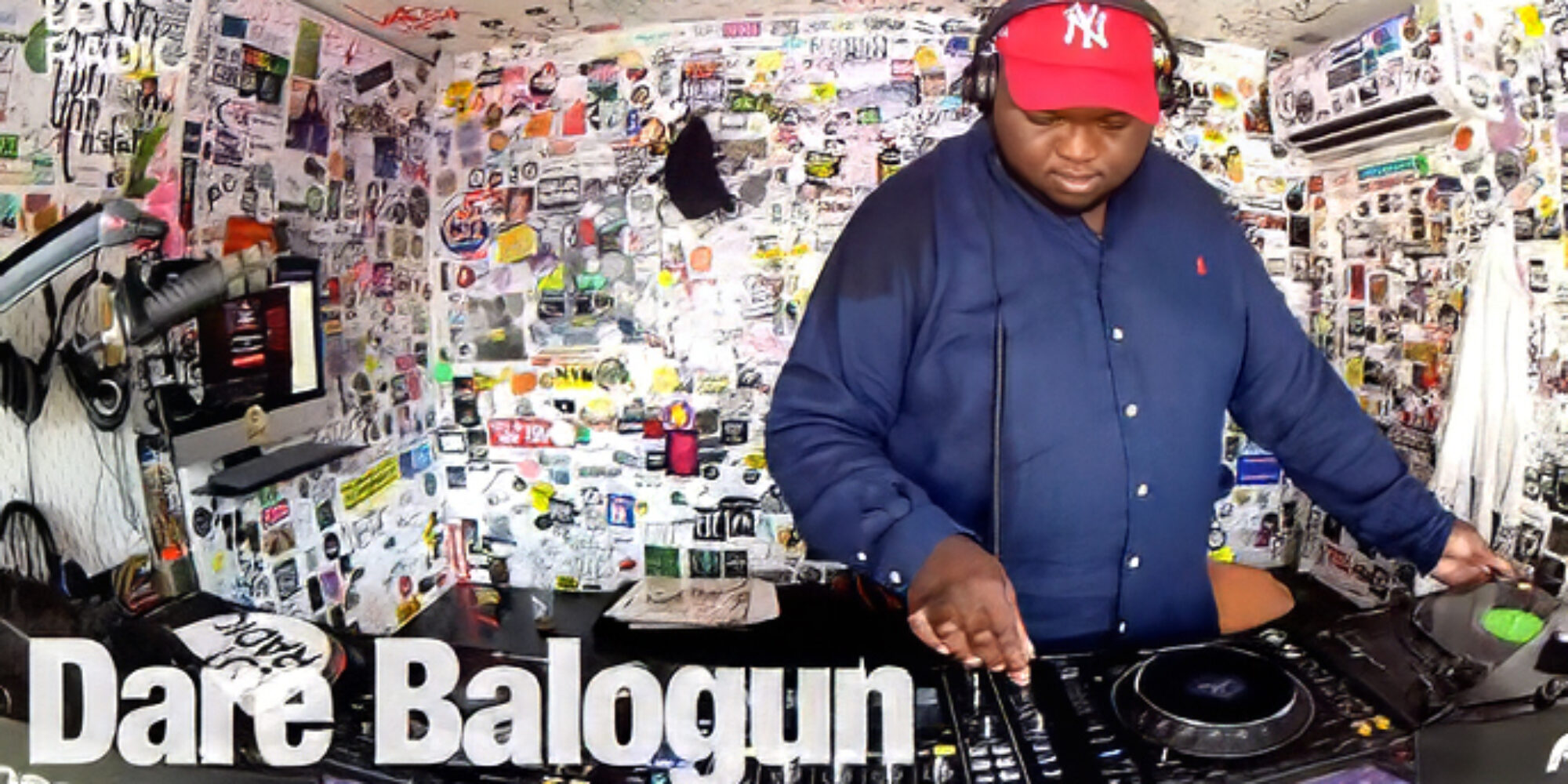
Dare Balogun is a London-based British-Nigerian DJ, selector and archivist. Through projects like Roots to Rhythm, and shows on NTS, and Balamii, he focuses on the feeling and soul of African music, bridging past and present expressions of joy and spirit to showcase the original meaning of music as a vehicle of pure elation. His sets blend highlife, soukous, desert blues and more in a diverse and holistic lesson on groove. Through both intimate listening sessions and ecstatic parties, he encourages reflection, appreciation and movement. Aside from events, Dare works to archive the music he presents, to build a digitized reference of music that can be used as a resource for generations to come.
I had the chance to talk to Dare about his background, philosophy and work to reaffirm the constant vitality of African music.
Dare Balogun can be found on instagram @darebalogun
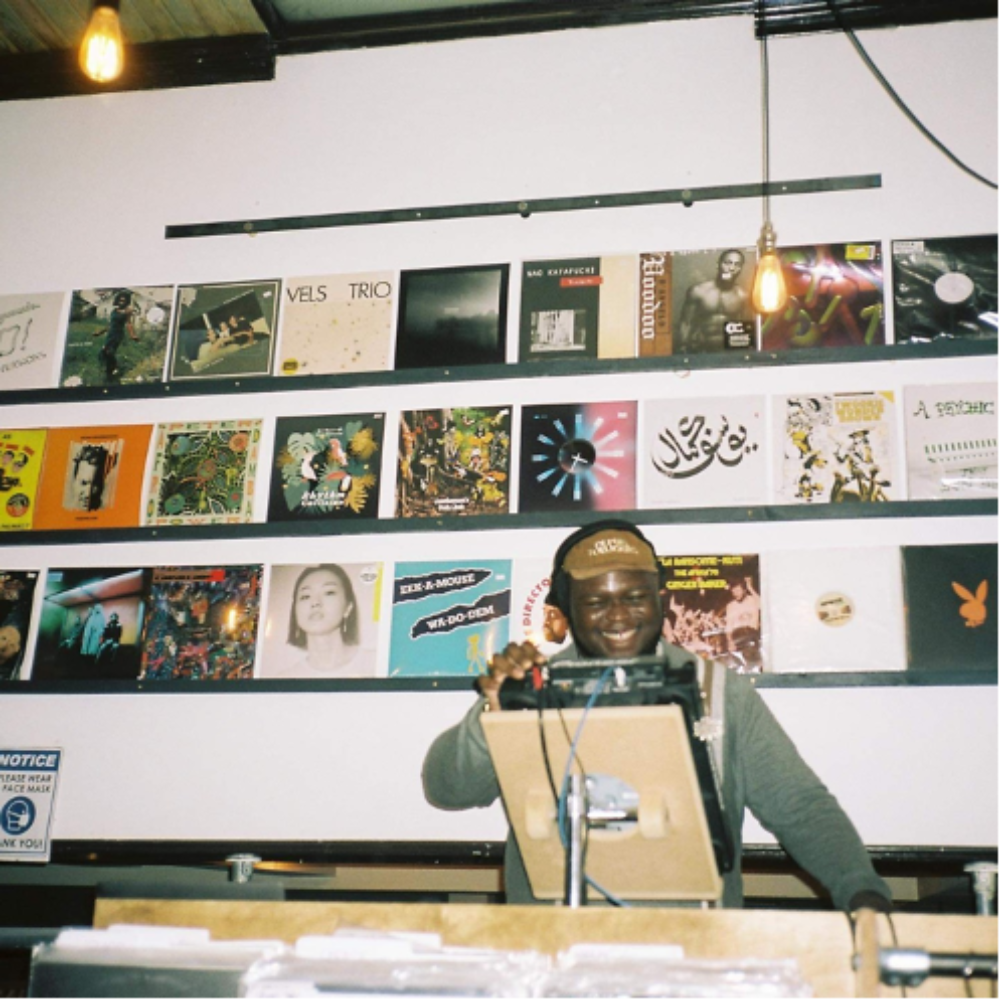
Ishaan Dasgupta: So, to begin with, tell us a bit about your background.
Dare Balogun: I was born in London, but I moved to Nigeria at a young age. I then moved back to the U.K. when I was 16, and went to boarding school in Cornwall. I think even from boarding school to university, I felt myself consciously or unconsciously suppressing my Nigerian identity. I lost my Nigerian accent; I feel I lost a lot of my culture.
When I started working at this advertising agency, again, I felt myself becoming this person I wasn't really. I wasn't being true to who I was. I wasn't being true to my own heritage. I’d become this homogenous person, I could fit into any box. I was very personable, but I just realized I was losing so much of myself.
As part of my old job, I went to Kenya to do a show with Boiler Room, and I went to this record shop called The Real Vinyl Guru. I'd already started collecting African records, but the approach I was taking, it was almost as if I wasn't African or I wasn't Nigerian. I was liike, "Wow, look at these rare finds." I didn't really know what it was. I didn't really know the music. I was just playing it because it sounded good, but I wasn't attaching any importance to it.
I think I spent four hours in this record shop. The owner was just talking to me about these genres of music and really introduced me to these genres of music that I'd heard of, but I'd never really understood. I think at that moment, I realized the importance of this music, not only to me, but to millions of people. I realized that even for me, I'd done myself a disservice by not playing this music and not sharing this music.
From that moment, I made a more conscious decision to apply the same approach I was taking with DJing, which was very research-led already—I'm a music nerd first and foremost—but just applying that to the music of where I'm from. I think that's been my philosophy since; it's just presenting the music where I'm from in the most authentic, incredible way with as much context as I can.
What’s your philosophy behind the Roots to Rhythm project?
Roots to Rhythm came when I met my collaborator Grace Shelley, who's also an amazing DJ. She was already playing on a radio station called Balamii, and she had a monthly show where she was playing African records. We got introduced because I also liked playing traditional African records, but I wasn't necessarily playing on the radio or anything. At that time, I was still playing house music, predominantly electronic music. I then started playing on Grace's show, and that's where I started playing African music.
We were thinking, in terms of feeling, that the feelings of elation or joy that I was getting from listening to Highlife and listening to Sokou and Makossa were the same feelings that you'd get listening to certain genres of black dance music, like Deep House, Detroit Techno. For us it was “how can we connect the dots between the two?” I think the belief in Roots to Rhythm is that if you look at music from West Africa as foundational music, and then as the roots, and then look at what we look at black dance music now as the rhythm, the whole point is to connect the dots. The first stop being forced migration. A lot of the people from West Africa moved to America due to slavery, and then you can still hear how that rhythm traveled. That's the whole point of Roots to Rhythm.
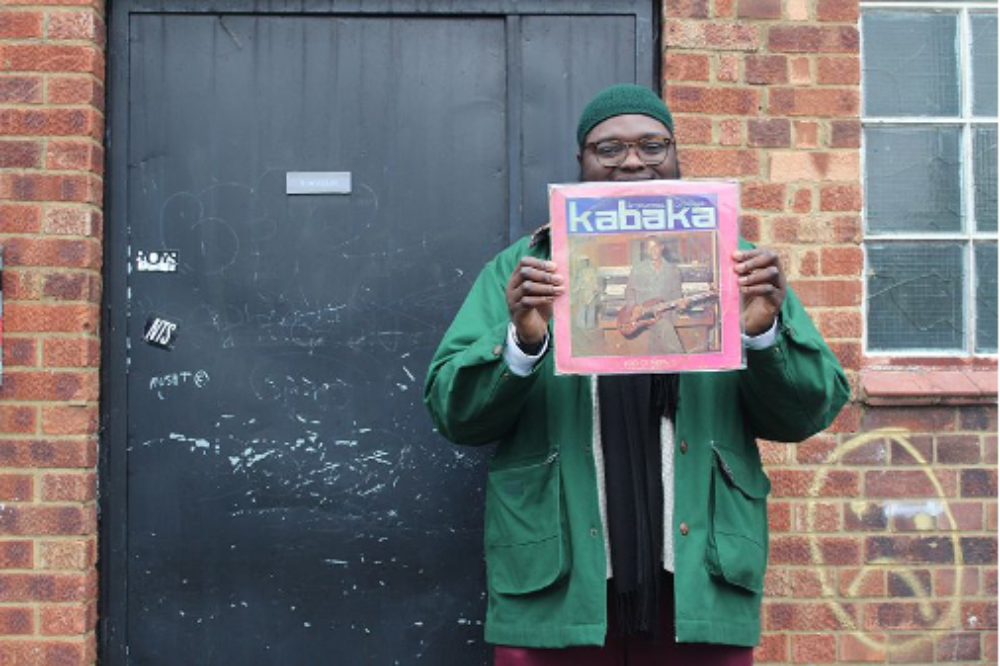
You mention connecting the dots, is there a balance to be found in cultural fusion and maintaining authentic expressions of African music?
I don't think there's a balance at all. I think I became a victim of the idea of multiculturalism in the U.K., particularly in the Western world. I think I became a victim of that, where it reduces everyone's culture. It becomes a thing where multiculturalism isn't necessarily all these rich and diverse cultures living side-by0side and coexisting, but more just the bits that appeal most to the dominant cultures in these countries are the things that are presented the most.
There is no balance. I had to make sure that what I'm doing is presenting this music in the most authentic way to Nigerians and to Africans. I think that was the biggest challenge I had; the people that exposed me to this music, unfortunately, weren’t my dad, it was people like Guts and Giles Peterson, a "world music" approach. I realized that these guys are just painting their own perspective on this music. Their own perspective is what's defining these tracks. If Giles Peterson plays a song from Marley, it's not about the song from Marley, it's the fact that Giles Peterson played it and the fact that Giles Peterson found it. Same thing with Guts, same thing with most diggers.
I realized that I had more of a responsibility because this is the music of where I'm coming from. There is no balance. I have to present the traditions. I have to present the communities where it comes from. I'm not trying to make it fit within any existing ecosystem. I have to present it unapologetically.
Do you feel a sense of duty then, to provide these authentic expressions?
I think so, for sure. I feel a big responsibility, an obligation. I think the responsibility first comes from undoing the actions of the past in terms of how this music is presented. I think that my first thing is just really challenging the way this music has been presented previously.
My second obligation is as a Nigerian. I'm a patriot to Nigeria, and by wider means, Africa. I think it's my obligation to export and present our culture as well, as a way of supporting Nigerians. My hope is that by sharing this music, there's more interest. Even if it's someone that listens to this track and is like, "I want to learn more". That could mean anything from Googling and reading a piece or editorial from a Nigerian artist or African writer, or going to the continent itself. I think it's just providing these points of introduction.
We’re seeing bands like Kokoroko and Ezra Collective being really popular now, bands who proudly show their West African roots. As well as this, we’re seeing a real boom in Latin music in the West (Reggaeton and Funk Carioca, for example), styles very much influenced by African music. What role do you think African music can play now in the cultural scene?
I think the role of African music now feels like the foundation or influence of a lot of genres which are popular now. African music now has the chance to sit alongside these genres. That's a really exciting possibility. When I play this music, I don't want it to—and I think that's where it's been difficult in the past— say "Oh, here's these old records, hear this music from a long time ago". You can still hear the elements of this music in the music that we listen to today. I think it shows that this music is just as relevant now as it was when it was initially released.
I think the excitement comes from being able to really position traditional African music as something that's not dated or a relic, but something that can sit alongside this wave of the same music that it influenced. I think for us, the goal is to not only play records from the 80s and 90s, but to play bands from now as well. When you think of people like Kokoroko and Ezra Collective, we need more of that. How can you start to really play all this stuff so it's not necessarily, "This is the past and this is the present", but music that just exists now.
You’ve touched on what you want the listener to feel, or ask, when they listen to what you play. Does the question of who the listener is concern you? What is the role of the non-African listener or consumer of this entertainment? Is there a way for them to listen appropriately and properly?
I think there is a way. I think it's just not to overthink it! I think that's where the problem has always lied, this almost unnecessary introspection. At the end of the day, I'm playing this music for a plethora of reasons, but those reasons are so personal to me. Part of that being that I'm African, I'm Nigerian. But when you see a DJ playing house music or electronic music, you don't ask why, you just dance. It's only when you see a DJ playing anything that feels outside of the space that it becomes a bit more, "Why? What's the context?" I think that's where it becomes challenging.
I think it's the spaces. For me, the majority of the places where I play, it's introspective—listening bars, in these audiophile things. I think the listener in those is a bit more engaged, they want to know. I think sometimes, “just leave it”. Just have fun, just enjoy it. This is music driven by healing first. For me, knowing the context and understanding the music helps to apply that feeling more. But it's music that you fall in love with, regardless. I think what's happening is too much introspection. I think people should just dance. People should just listen. A song isn't a think piece.
So, what kind of legacy do you want to leave with your work, what’s the end goal?
I think I want to use myself as an example for other people first. I think for so long, and even because of my own experience, I was a victim of playing what people want to hear. I think people should have confidence in their taste, regardless of whether it's in African music or in anything. I think I want to firstly be an example of that. This is the music I like, this is the music I'm passionate about, and this is the music I want to play, regardless of what's going on in the scene.
In terms of what I want to leave is building an archive of records. For me, that's the most important thing. Behind the DJing, behind the more fun stuff, is that I think 60% of recorded music in Nigeria before the 80s was all small print or very small labels. The majority of that was never digitized. The majority of that was never archived. If I can keep building traction, through DJing and my career, that gives me a lot more income and a lot more power to buy records, to build an archive, which is the biggest thing for me. Every record I buy, I digitize, I scan, and I upload onto an archive. As I continue to DJ, I continue to build this archive so hopefully even longer after I'm gone, this is a resource that people can use to really understand African music, not through the lens of a selector or through a DJ, but an actual resource.
There's this amazing book. It's a Comprehensive Guide to African Music by John Collins. It's such a good resource. I think what I'm hoping is that my work can also be used as a resource for students, for anyone who has an interest in African music, to refer to something that isn't through the lens of a digger, but an objective piece of reporting on this music.
I think archiving makes you feel like it's everything in the past, but I think archiving is in the present moments as well. It's capturing the present moments. That's the amazing part, even my sets. When I record my sets, it’s the first time that a record that’s been released in the ‘80s or ‘90s has been played in 2026. So it's right up in 2026. That moment of history isn't only then in the ‘80s and ‘90s, it's also contemporary. People think, archiving almost has this limit, that it only has to be things in the past. I think it's nice to be able to extend the history or extend the length of relevance for certain records. The past in dialogue with the present and future.
And finally, what’s next for you?
Honestly, I don't know! I know I want to keep building the archive and hopefully release it later this year. I want to keep doing what I'm doing now. Keep playing shows. I’m getting to play more dance floors, really to contextualize where the music is really meant to be played, outside of just listening bars.
I think the biggest context you can share this music is in situ, in parties, playing celebrations. I always talk about how the music I'm playing is music from weddings or music from ceremonies. People hear weddings and ceremonies and they don't realize that all I'm trying to say is that this is life.
Aside from that we have a bunch of listening sessions planned with MansA [Maison des Mondes Africains] in Paris.. The biggest thing is really just to try and find like-minded collaborators and venues and organizers who support the message and continue to build with us as well.
Thank you so much for your time, Dare. Wishing you all the best for 2026.
Related Audio Programs